
Less and more. Not so much.
Dieter Rams is big at the moment. His ten principles of good design seemed to explode around the interweb when the new Vitsoe site launched. He’s been profiled by the V&A as part of last year’s Cold War Modern exhibition. And Apple can’t launch a single product without Jonathan Ive’s name being linked to Rams’ time at Braun.
Reflecting the moment, London’s Design Museum is now showing an exhibition profiling the design ethos of the man himself.
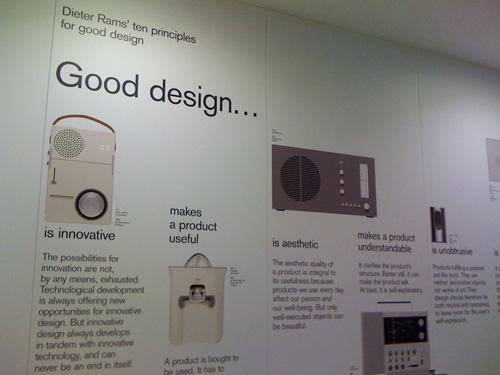
It’s a great exhibition and, as a fan of Rams’ work, it’s wonderful to be able to see so much of his work in one place. Certainly being able to see his designs as physical objects (rather than simply photos in a reference book or blog post) gives a different perspective and appreciation of what he managed to achieve in his time at Braun.
Scattered throughout exhibition are quotes from Rams. The first time that I read some of these I was slightly awe-struck at how much of his design ethos could be applied to service and interaction design:
A product must not claim features – more innovative, more efficient, of higher value – it does not have.
Whilst it’s great to get people excited about features coming tomorrow, those features aren’t a panacea for having a service that doesn’t work today. Transparency and honesty in design can go a long way in helping to create something useful for users from day one.
Because it is certainly unpleasant and tedious to be confronted day-in, day-out with products which are confusing, which literally get on our nerves, and with which we cannot relate.
Usability has always been a key part of interaction design, however, the ability to relate to the user is perhaps even more useful. It’s not just about designing something to be as simple as possible to use. It’s about being to empathise with the end user and knowing what their measure of simplicity is.
More can be found in Rams’ 10 principles of good design:
Good design is innovative.
Good design makes a product useful.
Good design is aesthetic.
Good design makes a product understandable.
Good design is unobtrusive.
Good design is honest.
Good design is long-lasting.
Good design is thorough down to the last detail.
Good design is environmentally friendly.
Good design is as little design as possible.
However, the more that I walked around the long, regimented lines of radios, stereos, shavers and kitchen appliances the more I felt that something was missing.
Passion.
Not passion for creating the most useful, honest and understandable products. But passion as a response to actually using a Braun appliance.
Yes, of course it’s great to have something that just works, that fits in your hand just so. That does everything you expect it to do. But that’s where these designs seem to end: they do everything you expect them to do and nothing more. Whilst that’s undoubtedly a big part of being honest, I can’t help but feel that there was something missing.
Going that little bit further. Surprise and delight the user. Don’t just be beautiful through utility, create passion by crafting an experience that quickens the breath just that little bit. The little intake that when you hear it you know that you’ve got someone hooked.
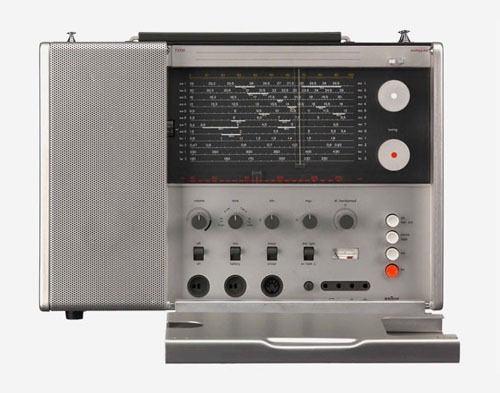
I know that several of my friends would dispute that Braun products don’t elicit a passionate response. One friend in particular purrs like a contented kitten at the thought of owning a T1000 World Receiver. Though I suspect that this response is heavily based upon what Rams’s work now represents rather than the experience of using such a design classic.
However, now more than ever, creating an experience that quickens the breath – whether it be a product or a service – may be the only way to creating brand loyalty and a relationship that lasts. After all, other than toothbrushes, who buys Braun now?