Will Technology Creation enter its own Age of Abundance?
The proliferation of computer software and the internet has brought many powerful tools to the masses.
From desktop publishing to cheap and powerful design tools, from affordable HD cameras to global publishing platforms such as blogs and YouTube, and self-publishing and self-marketing platforms such as Twitter and Facebook, technology has given power to the amateur and the semi-professional — the power to create media and content that can been seen by millions of people, quickly, cheaply, whenever and wherever.
This is the Age of Abundance. People love it. Now, anyone can create fan sites, parodies, anti-adverts and dissenting PR for their favorite/most-hated brands that are seen by millions. It creates challenges and opportunities for the worlds of marketing and advertising.
John Winsor, for example, created Victor & Spoils to build on crowd-sourcing principles. Victor & Spoils aims to tap into a broader client talent base than can be maintained within a single company and, notably, to co-create with consumers as well as with other creators. It is using this abundance to create a more diverse base of creativity.
At the same time, this technology shift has created a new opportunity to add value in a networked age. Call this ‘Ideas that do‘ or ‘marketing with meaning‘, advertising as a service, brand utility or one of any number of other terms, it involves leveraging networks in order to target specific users or customers. A large part will be technology creation, not just web platforms and iPad applications but networked FMCG products and internet-enabled real world devices.
In the past the advertising industry was able to create long-lasting cultural impact through Big Ideas and broadcast media but now the major effects on our culture, especially the ever-increasing network culture, are caused by innovations in technology and software platforms. To offer these same effects in the future we must look to Technology Creation.
Previously the marketing services industry has, in the majority, treated technology and especially the internet by using technology and not creating it. This is primarily through digital advertising on other technology platforms, videos on YouTube, search marketing, even microsites and brochureware sites — all of these are applications of technology but none involved the creation of technology.
As Mike Arauz says in Designing for Networks, agencies have used the internet primarily in traditional ways for awareness and persuasion and missed the greater opportunities of sharing, cooperation and collective action. In short they have treated the internet as just another media channel, competing in an attention war where abundance has created an infinite media landscape. I call this “pulling the levers on the electronic box”. Pulling the levers will always become commoditised because anyone can do it, especially as the levers inevitably become more and more user-friendly. Through Google AdWords, Google Places even somewhat through Google TV ads, Google has brought powerful advertising capability to everyone.
The problem is that the industry on the whole is so far away from the technology creation landscape, because mostly it is still stuck in the lever-pulling business. You can see this by checking a few basic facts: How many technology innovators are in the industry? How many of them could really build the next FourSquare? How many agencies have a CTO on the board at the highest level?
Technology Creation is a scarcity
Technology Creation is difficult. It requires difficult-to-learn skills and — often — a multi-disciplinary team. System and service design necessitates close collaboration between behaviour experts, designers and engineers. It is a collaborative and iterative process that can rarely be done by one person alone. Programming skills especially are not owned by the masses.
The fact that Technology Creation is scarce means that a premium still applies to it. Look at some of the companies with the largest market caps — Apple, Google and even Exxon. The market believes their future ability to create new technology is what will drive them to greater profits in the future (Microsoft may no longer be in this category). The great technology creator — talent — is rare and these companies are masters at finding and fostering the best talent, from awesome designers like Jonathan Ive to the ranks of great engineers at Google.
Some may say that open-source software is a crowd-sourced example of Technology Creation but that is not how open-source projects work. All successful open-source software (for example Apache, Linux, Ruby On Rails) is initially created by either one person of a small group of people. In a lot of cases the origin is within a large company (Google has released over 500 open source projects).
After this initial creation, open-source projects are run by a small group, the core-commiters, often under a benevolent dictator. Other people use that technology by remixing it into other acts of Technology Creation and remixing patches or features which are then curated by the core-commiters back into the project.
Before there is Technology Creation there will be Technology Remixing
I believe the industry is transitioning through the era of Technology Remixers. These are the people who understand broadly how technologies work, can understand trends and behaviours and know how to remix existing open source software and APIs of services and platforms (ie. Twitter, Facebook, FourSquare etc) to create new experiences. They will be able to bring together technology with new ideas and capitalize on what is out there with basic amounts of engineering talent. A lot of the technology outputs from agencies in the digital space is technology remixing.
There are some who say this is as far as agencies need to go, that you can achieve great things by remixing existing technology and that agencies should not be in the game of Technology Creation. The problem is that the industry will only become truly relevant again to an age of networks and technology when it can conceive and create whole new technology experiences. That is not to say that all traditional marketing/advertising activity will disappear. There will always be money to be made in advertising, just not as much money. The effect of content and media experiences on long-lasting, global technology culture is far less than the effect of technology innovation.
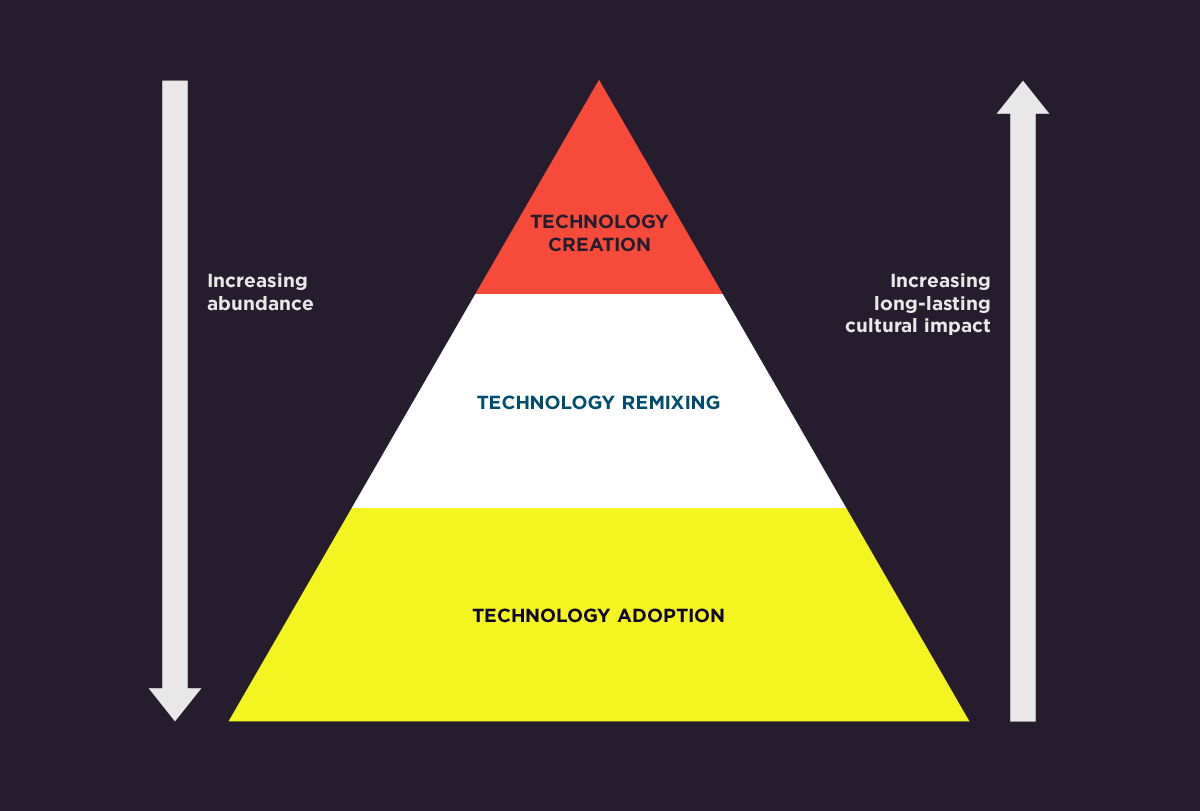
Hierarchy of Technology Creation
What happens as Technology Remixing and Technology Creation move towards abundance?
We can predict this because Technology Remixing is rapidly moving towards the same abundance as digital content. This is still a way into the future because at the moment the consumer is not a programmer, but as subsequent generations become more digitally literate, their capacity to remix and create technology increases. The primary reason for this is that these consumers have no fear: they expect technology to work for them. I’m reminded of the Douglas Rushkoff speech at SXSW “Program or be Programmed” (at the end of this post) where he raises a call to arms for people to learn how to code and design their own systems, or be programmed to live with the limits of existing legacy code and institutionally-defined behaviors.
“If you are not a programmer, you are being programmed…. We got the computer which meant that anyone could be program reality, but that’s not what happened… We got the computer, did we get a nation of programmers, no we got a nation of bloggers… If we don’t create a society that at least knows there is a thing called programming then we will end up being the users, and worst, the used.” – Douglas Ruskoff taken from Program or be Programmed
As the digital generation grows up, Technology Remixing and Technology Creation will enter their own Ages of Abundance and the chance to have cultural impact reduced. There are indicators to this behaviour. Arduino is opening up simpler ways to create interactive object and environments and is being taken up by hobbyists — for example, you can build your own EcoDrive with Arduino and MPGuino. Low-cost desktop 3D printing will allow people to create their own physical objects, reducing the copying cost of physical production in the same way the internet has reduced the distribution and copying of digital objects to near zero. These are signposts on a road to abundance of Technology Creation.
Abundance breaks more things than scarcity does. Society knows how to react to scarcity. – Clay Shirky
If Technology Creation becomes abundant then all bets are off. People will solve their own problems through technology and distribute those solutions to others at lower and lower costs. More collaborative software will allow small disparate teams with different skill sets to work together to solve a common problem. The growth of Technology Creation has a direct knock-on effect on the diversity and power of Technology Remixing and the impact of technology adoption to produce new forms of digital content. As a new generation emerges the technology landscape will tend to infinity.
So is Technology Creation going to be in your future?